

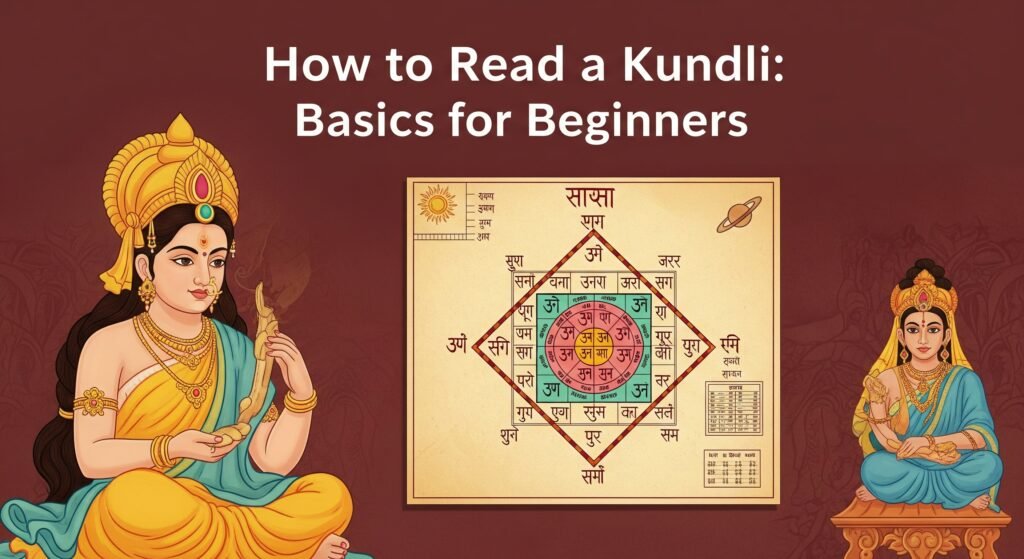
Reading a kundli can be difficult when you are not well aware of the vivid astrological terms. The initial understanding of a kundli requires developing more knowledge on astrology.
However, in this blog, we will help you understand how to read your own Kundali in simple steps.
Step 1: Let’s Understand the Anatomy of Kundli
By reading a birth chart (kundli), you can learn about your past, present and future as per astrologers at top10astrologers. At times, your birth chart may not be an accurate predictor of your future, but it tells you about directions in your life.
Through accurate kundli reading, you can prepare yourself for the good and the bad parts in the future. Kundli is your astrological diagram, which represents your place, time and date of birth. Using all these aspects. Astrologers at top10astrologers create Kundli, which is unique to an individual’s time, date and place of birth.
Step 2: Understand Ascendant Signs and Houses in Kundli
Kundli can depict the astrological positions and planetary angles at the time of your birth, which helps in predicting your future life trajectory. To understand and read your Kundli by yourself requires learning about astrological signs and symbols.
The first and foremost thing that you should know is your rising sign. It is also the ascendant sign. Astrologers use numeric digits to identify the placement of the planets in your Kundli. The ascendants’ numbers range from 1 to 12. Similarly, there are 12 houses in your Kundli, which are indicated by Roman numbers I to XII.
The table below highlights the numbers associated with ascendant signs and houses –
| Numeric Numbers | Rising Sign | Houses | Significance of Each House |
| 1 | Aries | I. First House | The first house represents the physical features of an individual, along with their characteristics and personality |
| 2 | Taurus | II. Second House | Primary knowledge, wealth, family, and finances |
| 3 | Gemini | III. Third House | Hobbies, skills, efforts, communication, and younger siblings |
| 4 | Cancer | IV. Fourth House | Mother, happiness, land, secondary education, vehicle, and property |
| 5 | Leo | V. Fifth House | Creativity, higher education, love and affairs, wittiness, past life experiences |
| 6 | Virgo | VI. Sixth House | Profession, debt, diseases, enemies, and advocacy |
| 7 | Libra | VII. Seventh House | Spouse, marriage, import-export, long-term relationships, and partnerships, public image |
| 8 | Scorpio | VIII. Eighth House | Unexpected incidents, longevity, and research |
| 9 | Sagittarius | IX. Ninth House | Higher learning, beliefs, beliefs, father, mentor, long-distance travel, and religion |
| 10 | Capricorn | X. Tenth House | Karma, career, profession, and job |
| 11 | Aquarious | XI. Eleventh House | Income, ambitions, elder siblings, profits |
| 12 | Pisces | XII. Twelfth House | Expenditure |
Step 3: Understand Planet Positioning in Kundli
Your kundli captures and provides a representation of planetary position and constellations at the time of your birth.
To understand a kundli, you should know the abbreviations used to indicate the planet positions. The planets comprise of sun, moon, Mercury, Mars, Venus, Jupiter, Saturn, Rahu, and Ketu. In this step, you should identify the planet in each house.
Each planet has its behaviour and characteristics. Their behaviour change in the combination of different planets and zodiac signs. For example, Saturn becomes the enemy of the Aries sign and planet Venus. So, if the placement of all of these is together, it could lead to bad outcomes.
To Sum Up
By reading and analysing planetary relationships, you can understand which planet is exalted (stronger due to positive effects) and which is debilitated (weakened due to negative effects). There is a distinct role of houses and planetary relationships in the events of life.
Top10Astrologers have professionals who can guide you in figuring out your Kundli. You can schedule an online consultation with astrologers available at top10astrologers to seek guidance.